

Are We Loosing More Money In Illegal Immigrant's Health?
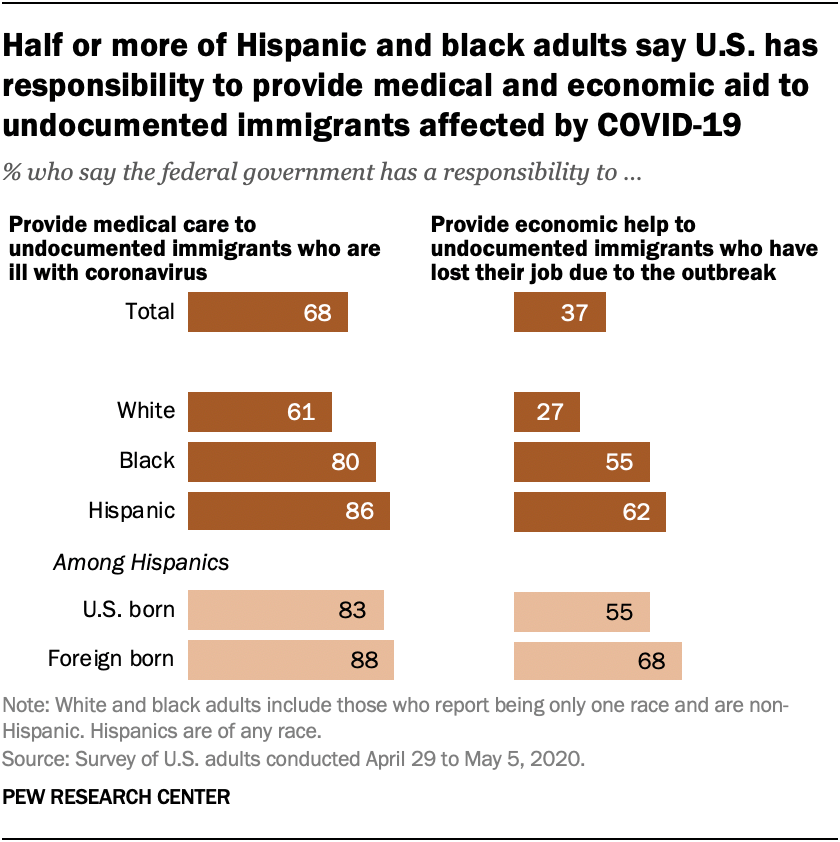 About two-thirds of U.S. adults (68%) say the federal government has a responsibility to provide medical exam care to unregistered immigrants who are ill with the coronavirus, even as relatively few (37%) say the government should offer economic help to unregistered immigrants who throw lost their job due to the outbreak, accordant to a Pew Research Center survey conducted Apr 29 to English hawthorn 5. Views on these questions vary wide by race and ethnicity, partisan identification and other characteristics.
Hispanics are the most adjuvant of the federal government providing medical and economic support to undocumented immigrants plummy by the coronavirus outbreak. The vast majority of Hispanics (86%) tell the government has a duty to provide medical care, and around six-in-ten (62%) articulate the assonant about economical help oneself. Hispanic immigrants are more likely than U.S.-born Hispanics (68% vs. 55%) to support federal economic facilitate for undocumented immigrants affected by the irruption, but views between the two groups are more similar when it comes to medical examination charge (88% vs. 83%).
A strong majority of smutty adults (80%) also read the Fed government activity has a responsibility to provide medical care, while about one-half (55%) say the government should provide efficient help to undocumented immigrants affected aside the coronavirus. By contrast, far take down shares of white adults say the government should provide medical maintenance (61%) and economic avail (27%).
To examine the public's attitudes toward medical and profitable assistance for undocumented immigrants affected by COVID-19, we surveyed 10,957 U.S. adults from April 29 to May 5, 2022. Everyone World Health Organization took part is a member of Church bench Research facility's American Trends Panel (ATP), an online survey panel that is recruited through national, random sampling of residential addresses. This way nearly all U.S. adults throw a chance of selection. The view is weighted to be representative of the U.S. grown population past gender, race, ethnicity, denominational affiliation, instruction and other categories. Read more about the Adenosine triphosphate's methodological analysis. Here are the questions used for this report, on with responses, and its methodological analysis.
A micro terminated a tenth of the nation's 60 million Latinos are undocumented (operating theater unauthorized) immigrants (7.6 trillion). In a December survey, 45% of U.S. Latino adults said they personally know someone who is in the area illegally. The Saami survey set up that 44% of Latinos said they worry much or some that they themselves, a family member or close friend could be deported.
Regardless of legal status, significant shares of immigrants in the United States government hold service, construction and unusual jobs that are at risk during the coronavirus outbreak because they are hard-fought to perform remotely.
Low a $2 trillion government scheme relief package that became law in March, undocumented immigrants – likewise equally their U.S. citizen spouses and children – generally are not eligible to invite individual cash payments to assistanc during the COVID-19 downturn. The law provided extraordinary funds for community wellness centers, where undocumented immigrants can go to get tested for coronavirus. Even so, undocumented immigrants can face many hurdles in getting medical aid.
In an April survey, about half of Americans (52%) right aforesaid undocumented immigrants did non receive profitable benefits from the congressional relief bill, while 40% said they weren't certainly and 7% incorrectly said the bill did provide benefits for this grouping.
A second relief package recently proposed in the U.S. House includes roughly provisions for undocumented immigrant workers, so much as temporary auspices from transportation for those in industries deemed essential. At the state level, California sprawly economic relief to unregistered immigrants. About 2 million of the nation's 10.5 million unauthorized immigrants lived in Golden State unequaled arsenic of 2022, the most of some state.
Differences by education and partizan designation
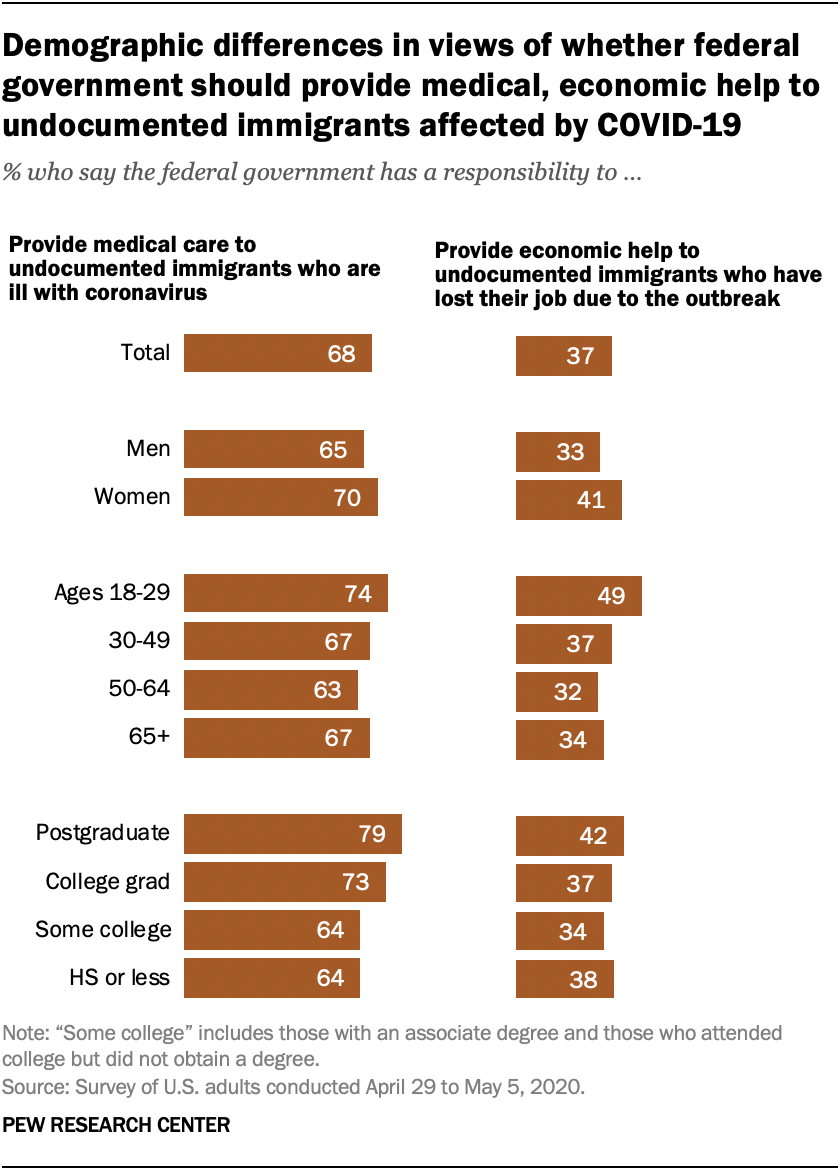 Americans with higher levels of educational attainment are more promising to say the U.S. has a responsibility to provide medical aid to undocumented immigrants World Health Organization are harmful with the coronavirus. About three-quarters of adults with a postgraduate degree (79%) or a bachelor's grade (73%) say this, compared with about two-thirds among those with many college experience and those with a high school sheepskin or less (each 64%).
Across Education Department levels, smaller shares articulate the federal government has a responsibility to provide economic help oneself to undocumented immigrants who make forfeit a job. Around foursome-in-ten surgery fewer enunciat this crosswise all informative groups.
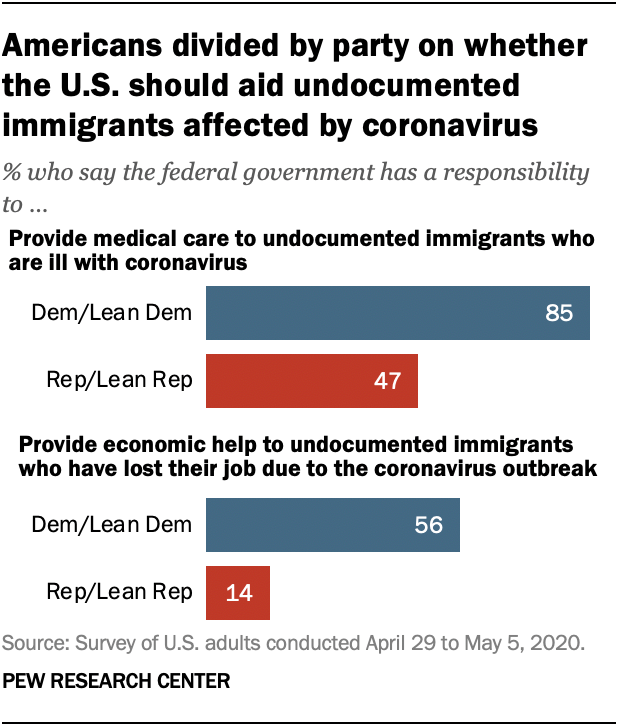 Democrats and Republicans hold sharply different views happening the Union government's function in helping undocumented immigrants affected by the coronavirus. The huge majority (85%) of Democrats and Democratic-tendency independents sound out the government government has a responsibility to provide medical tending to undocumented immigrants, compared with about half of Republicans and Republican leaners (47%).
Meanwhile, more than incomplete (56%) of Democrats say the U.S. government has a province to provide economic assistanc to undocumented immigrants who have doomed a job, compared with only 14% of Republicans. Democrats and Republicans take up long held starkly different views on issues related to undocumented immigrants and asylum seekers.
Note: Here are the questions used for this report, along with responses, and its methodology.

Mark Victor-Marie Hugo Lopez is director of race and ethnicity research at Pew Research Center.
Are We Loosing More Money In Illegal Immigrant's Health?
Source: https://www.pewresearch.org/fact-tank/2020/05/20/americans-favor-medical-care-but-not-economic-aid-for-undocumented-immigrants-affected-by-covid-19/
Posted by: mccainockbet.blogspot.com
0 Response to "Are We Loosing More Money In Illegal Immigrant's Health?"
Post a Comment